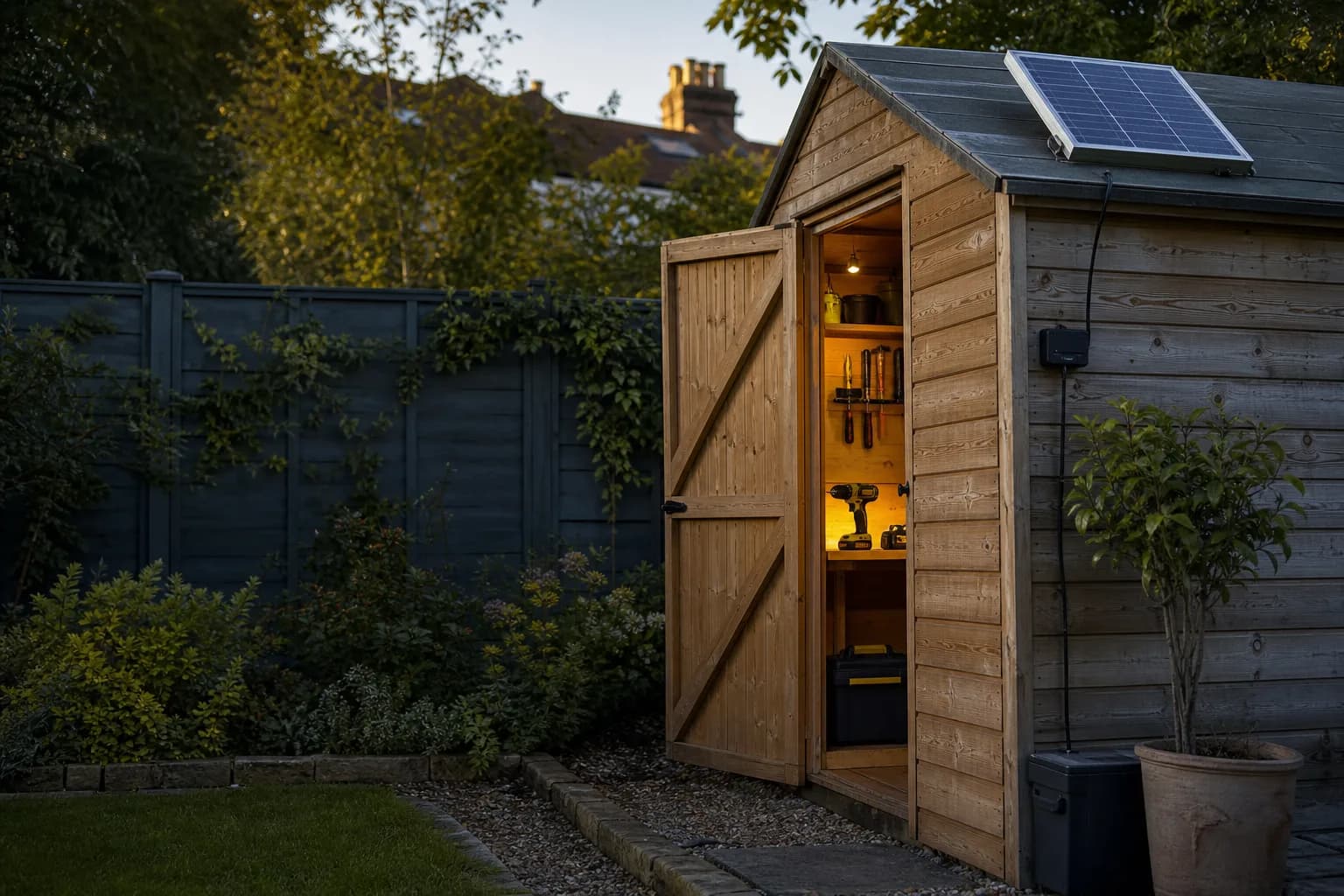
Sheds and workshops
Build the right off-grid shed solar kit
Size the kit from daily energy and the highest load running at once. A lighting setup and a tool-ready workshop need completely different equipment.
Reviewed 24 July 2026 · Off-grid planning only, not fixed-wiring or installation advice.
What an off-grid shed system contains
- Solar panels
- Generate DC electricity. Rated watts describe test-condition output, not daily energy or guaranteed UK production.
- Charge controller
- Regulates panel energy going into a separate battery. It must be compatible with the panel array and battery; this is not a component to guess from connector shape.
- Battery
- Stores energy in Wh. Battery chemistry, usable capacity, permitted temperature and protective controls matter as well as the headline number.
- Inverter
- Converts DC to AC for suitable appliances. Its continuous and surge limits are separate from battery capacity.
An integrated portable power station combines the controller, battery, inverter and controls in one manufacturer-supported unit. A component kit can be more configurable, but safe design of protection, cables, connectors and fixed outlets requires appropriate competence.
Work out watt-hours before choosing a kit
Watts describe demand at a moment. Watt-hours describe energy over time. Multiply each appliance's running watts by its daily hours, then add the results. Check rating plates rather than relying on the examples below.
| Use case | Assumed loads | Daily energy | Main constraint |
|---|---|---|---|
| Lights and charging | Two 5 W LEDs × 4 h; phone at 15 W × 2 h | 70 Wh | Cloudy-day reserve rather than inverter power |
| Desk in a shed | 50 W laptop × 6 h; 10 W router × 10 h; 10 W light × 5 h | 450 Wh | Reliable winter recharge and battery reserve |
| Occasional workshop | 600 W tool × 30 min; 100 W extractor × 1 h; 20 W lighting × 4 h | 480 Wh | Tool and extractor start-up watts, not just daily Wh |
The workshop example uses less daily energy than an all-day computer, but may need a much larger inverter because its loads are powerful while running. Motors and compressors can demand more at start-up.
400 W versus 800 W of panels
Doubling rated panel wattage can increase potential generation and shorten recharge time when the battery can accept the input and the panels receive useful sun. It does not guarantee twice the energy: shading, orientation, controller limits, temperature and a full battery can all constrain output.
A 400 W array may be ample for modest, intermittent loads in brighter months. An 800 W array provides more charging potential for a daily office or workshop, but winter autonomy still depends on stored energy and weather. Do not connect panels beyond the controller or power station's stated voltage, current or power limits.
For the wider office calculation, read solar power for a garden office. The main solar calculator gives broad UK generation context but is not an off-grid kit designer.
Heating, kettles and larger tools
A 2,000 W heater consumes 2,000 Wh in one hour. That is more than 28 times the basic daily example. A kettle may run briefly, but the inverter still has to support its high instantaneous load. Table saws, compressors and dust extractors can combine high running power with start-up surge.
Treat these as separate design cases. For a frequently used workshop or electrically heated building, ask a competent professional to assess whether a properly installed mains supply or another heating strategy is more practical.
Positioning and seasonal reality
- Avoid shade from the shed roof edge, trees, fences and neighbouring buildings across the whole day.
- Secure panels with a mounting system designed for the location and expected wind loads.
- Keep connectors and equipment within their stated weather-resistance limits; a garden building can be damp, dusty or very hot.
- Expect substantially less available solar energy on short, overcast winter days than in summer.
- Plan a safe alternative charging route or reduce loads rather than assuming the battery will always recover by the next day.
Electrical safety boundaries
Plugging suitable appliances directly into a manufacturer-provided portable power station is different from installing fixed sockets in a building. Fixed wiring, protective devices, earthing and outdoor cable routes should be designed and installed by a competent electrician.
- Inspect tools, plugs and leads before use and stop if they are damaged, overheated or repeatedly trip protection.
- Keep cables away from blades, doors, standing water and trip routes.
- Check that equipment is suitable for damp or dusty conditions and that the supply supports its rating-plate load.
- Follow the battery and inverter manufacturer's ventilation, temperature, charging and storage instructions.
The UK plug-in solar guide applies to the separate mains-connected category.
Shed kits and components to compare
A power station and panel sold together can simplify a small shed setup. A component system gives more choice but needs careful electrical and installation planning.
Victron Energy
20W Mono Solar Panel
Sold by Bimble Solar
A rigid solar panel for a correctly designed off-grid component system.
Best for: Maintenance charging and very small lighting loads where the calculated energy need is genuinely modest.
- Panel power: 20 W
- Maximum-power voltage: 21.3 V
- Maximum-power current: 0.95 A
- Open-circuit voltage: 24.7 V
Check before buying: Match the product’s current manual to your calculator result and intended connections.
Affiliate linkView latest price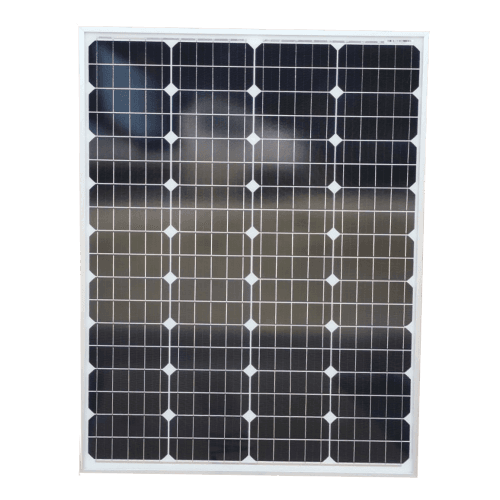
Victron Energy
95W Mono Solar Panel
Sold by Bimble Solar
A rigid solar panel for a correctly designed off-grid component system.
Best for: A small rigid panel for light shed loads or maintenance charging in a correctly designed off-grid system.
- Panel power: 95 W
- Maximum-power voltage: 17.6 V
- Maximum-power current: 5.42 A
- Open-circuit voltage: 20.4 V
Check before buying: Match the product’s current manual to your calculator result and intended connections.
Affiliate linkView latest price
Victron Energy
SmartSolar MPPT 75/15 Charge Controller
Sold by Bimble Solar
A standalone solar charge controller requiring compatible panels, battery settings, wiring and protection.
Best for: Controlling a compatible small panel array charging a correctly configured 12 V or 24 V battery.
- Rated charge current: 15 A
- Battery voltage: 12V / 24V auto-select
- Nominal PV power at 12 V: 220 W
- Nominal PV power at 24 V: 440 W
Check before buying: Match the product’s current manual to your calculator result and intended connections.
Affiliate linkView latest priceBLUETTI
AC50B with 100W Solar Panel
A power station and solar-panel bundle sold together by the manufacturer.
Best for: A compact bundle for lighting, charging and modest loads.
- Capacity: 448 Wh
- batteryCapacityWh: 448 Wh
- Continuous output: 700 W
- maxSolarInputW: 200 W
Check before buying: Match the product’s current manual to your calculator result and intended connections.
Affiliate linkView latest priceEcoFlow
RIVER 3 Plus Solar Generator with 60W panel
A power station and solar-panel bundle sold together by the manufacturer.
Best for: A small power station and panel bundle for light shed essentials.
- Capacity: 286 Wh
- batteryCapacityWh: 286 Wh
- Continuous output: 600 W
- surgeOutputW: 1200 W
Check before buying: Match the product’s current manual to your calculator result and intended connections.
Affiliate linkView latest priceRenogy
200W 12V/24V Premium Solar Kit with Rover 20A Controller
An off-grid solar kit containing panels and charging equipment.
Best for: A component-based shed system where the battery, inverter and wiring are designed separately.
- Panel power: 200 W
- Charge controller: 20 A
Check before buying: Match the product’s current manual to your calculator result and intended connections.
Affiliate linkView latest priceRenogy
Core Mini 12.8V 100Ah LiFePO4 Battery
A LiFePO4 battery for a compatible off-grid component system.
Best for: Battery storage for a correctly designed 12 V component system.
- Nominal voltage: 12.8 V
- Battery capacity: 100 Ah
Check before buying: Match the product’s current manual to your calculator result and intended connections.
Affiliate linkView latest price| Product | Verified specifications | Best for | Details |
|---|---|---|---|
| Victron Energy 20W Mono Solar Panel | Panel power: 20 W; Maximum-power voltage: 21.3 V; Maximum-power current: 0.95 A; Open-circuit voltage: 24.7 V; Short-circuit current: 1.99 A; Height: 450 mm; Width: 275 mm; Thickness: 25 mm; Weight: 1.3 kg; Cell type: Monocrystalline | Maintenance charging and tiny loads. | View card |
| Victron Energy 95W Mono Solar Panel | Panel power: 95 W; Maximum-power voltage: 17.6 V; Maximum-power current: 5.42 A; Open-circuit voltage: 20.4 V; Short-circuit current: 5.7 A; Height: 770 mm; Width: 668 mm; Thickness: 30 mm; Weight: 5.4 kg; Cell type: Monocrystalline | Small off-grid charging, not high-power loads. | View card |
| Victron Energy SmartSolar MPPT 75/15 Charge Controller | Rated charge current: 15 A; Battery voltage: 12V / 24V auto-select; Nominal PV power at 12 V: 220 W; Nominal PV power at 24 V: 440 W; Maximum PV open-circuit voltage: 75 V; Maximum PV short-circuit current: 15 A; Maximum efficiency: 98%; Bluetooth: Built in; Communication: VE.Direct; Weight: 0.5 kg; Height: 100 mm; Width: 113 mm; Depth: 40 mm | Compatible small panel and battery systems. | View card |
| BLUETTIBLUETTI AC50B with 100W Solar Panel | Capacity: 448 Wh; batteryCapacityWh: 448 Wh; Continuous output: 700 W; maxSolarInputW: 200 W; Panel power: 100 W | Compact shed bundle. | View card |
| EcoFlowEcoFlow RIVER 3 Plus Solar Generator with 60W panel | Capacity: 286 Wh; batteryCapacityWh: 286 Wh; Continuous output: 600 W; surgeOutputW: 1200 W; maxSolarInputW: 220 W | Light-duty shed essentials. | View card |
| RenogyRenogy 200W 12V/24V Premium Solar Kit with Rover 20A Controller | Panel power: 200 W; Charge controller: 20 A | Component-based shed solar. | View card |
| RenogyRenogy Core Mini 12.8V 100Ah LiFePO4 Battery | Nominal voltage: 12.8 V; Battery capacity: 100 Ah | Planned 12 V battery systems. | View card |