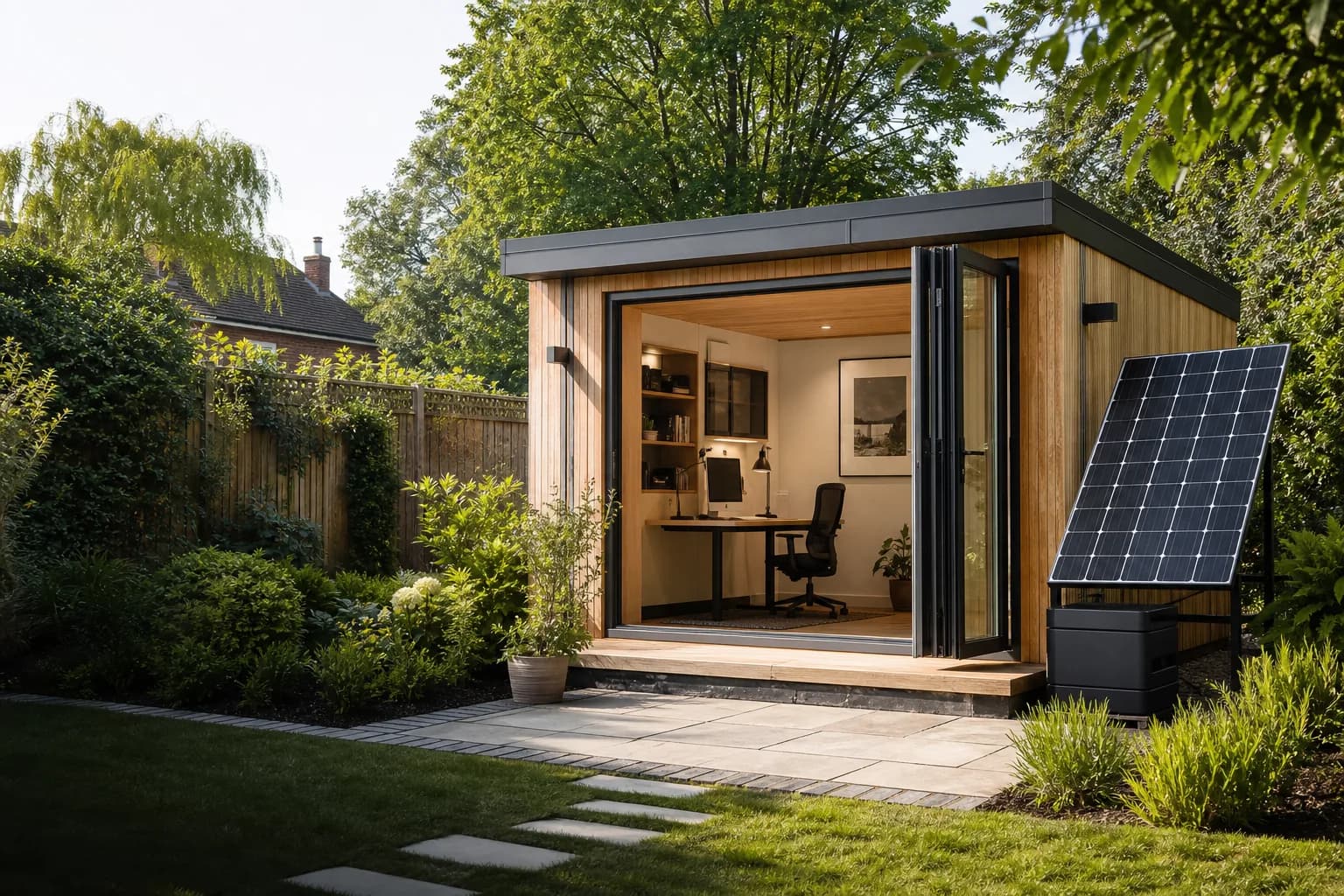
Off-grid garden buildings
Solar power for a garden office
Turn real laptop, screen, Wi-Fi and lighting loads into a practical off-grid shortlist. Heating, kettles and large tools change the calculation dramatically.
Reviewed 24 July 2026 · Portable and off-grid systems, not mains-connected installation advice.
Start with energy use, not panel size
List each appliance, its running power and how long it will be used. Multiply watts by hours to get watt-hours. A 50 W laptop used for six hours consumes 300 Wh. Add every appliance to estimate one day's energy before allowing for conversion losses and poor solar weather.
- Solar panel wattage
- The panel's rated output under test conditions. Real output varies with sunlight, temperature, angle and shade.
- Battery capacity
- Stored energy, normally stated in Wh. Not all stated capacity will necessarily be available at the AC sockets.
- Inverter output
- The maximum AC load the system can supply, including any start-up surge allowed by the manufacturer.
- Daily energy use
- The total Wh used over a day. This determines how much storage and solar recharge the office needs.
Three worked garden-office setups
These examples are planning assumptions, not product specifications or guaranteed performance. Check every appliance rating plate and allow for inverter losses and less productive winter days.
| Setup | Assumed daily use | Daily energy | What to plan around |
|---|---|---|---|
| Basic | 10 W LED × 5 h; phone charge at 15 W × 2 h | 80 Wh | Small loads; leave margin for cloudy periods |
| Everyday office | 50 W laptop × 7 h; 30 W monitor × 7 h; 10 W router × 10 h; 10 W light × 5 h | 710 Wh | Roughly 0.71 kWh before losses; winter recharge is the constraint |
| Larger office | 100 W computer × 7 h; two 30 W monitors × 7 h; 15 W network equipment × 10 h; 20 W lighting × 6 h | 1,390 Wh | Higher battery capacity, inverter headroom and more solar input |
A battery should not be selected by matching its headline Wh figure exactly to the table. Allow for usable capacity, conversion losses, battery reserve and the number of low-sun days you want to tolerate. For a desktop or gaming setup, use the solar-powered computer guide and calculator to check the PC, display and peak workload together.
Why heating and kettles dominate the design
A 1,500 W resistance heater used for two hours consumes 3,000 Wh—more than four times the everyday-office example. A 2,000 W kettle running for six minutes uses about 200 Wh and also requires an inverter able to supply roughly 2,000 W at that moment. Large saws, compressors and pumps may draw a substantial start-up surge as well as a high running load.
Solar can make a useful contribution to comfort, but direct electric heating is often a poor match for a small off-grid system because heat demand is highest during the least productive solar months. Improve insulation and draught control first, and treat any electric heating load as a separate sizing decision.
Panels, position and UK seasons
Put panels where they receive consistent light without shade from the office, fences or trees. A south-facing position normally maximises total generation, while east or west can better match morning or afternoon work. Shading can matter more than nominal panel wattage.
Panel ratings are not a promise of continuous output. Short winter days, low sun and poor weather can leave an office dependent on stored energy or another charging source. Use the main UK solar calculator for broad solar-output context, but do not treat its grid-connected savings model as an off-grid battery-sizing result.
A practical off-grid route
- Measure or read the rating plate for each intended appliance.
- Calculate normal daily Wh and the highest simultaneous watt load.
- Decide how many low-sun days the battery should cover.
- Check panel input, battery limits and inverter output in the manufacturer's instructions.
- Keep fixed sockets and wiring outside a DIY portable-power plan.
Compare the component approach in the off-grid shed solar kit guide with the simpler all-in-one route in the garden-office power station guide.
Electrical and battery safety
- Never connect a portable power station or off-grid inverter to a household socket or fixed circuit.
- Use a competent electrician for fixed sockets, lighting circuits, earthing or a mains supply to an outbuilding.
- Use equipment only within its manufacturer-stated temperature, ventilation, moisture and load limits.
- Keep cables protected from water, sharp edges, doors and trip damage; stop using damaged plugs, leads or equipment.
- Do not cover a power station while charging or operating, and do not use a swollen, damaged, unusually hot or recalled battery.
- For workshop loads, check that the supply can support both running and start-up demand.
The UK plug-in solar legal guide covers the separate position for systems connected to the household electricity supply.
Garden-office kit shortlist
Choose from the calculated battery and inverter requirements, then check solar input and winter recharge. These portable products are not mains-connected plug-in solar systems.
EcoFlow
DELTA 3 Series Portable Power Station
A portable power-station range with multiple capacity or expansion choices.
Best for: Expandable capacity for an office whose measured load may grow.
- Expandable capacity: 1-5 kWh
- Capacity: 1024 Wh
- batteryCapacityWh: 1024 Wh
- Continuous output: 1800 W
Check before buying: Match the product’s current manual to your calculator result and intended connections.
Affiliate linkView latest priceJackery
Solar Generator 1000 v2
A power station and solar-panel bundle sold together by the manufacturer.
Best for: A power station and solar-panel bundle for a measured office load.
- Capacity: 1070 Wh
- batteryCapacityWh: 1070 Wh
- Continuous output: 1500 W
- surgeOutputW: 3000 W
Check before buying: Match the product’s current manual to your calculator result and intended connections.
Affiliate linkView latest priceBLUETTI
AC50B with 100W Solar Panel
A power station and solar-panel bundle sold together by the manufacturer.
Best for: A compact bundle for efficient lighting, networking and laptop use.
- Capacity: 448 Wh
- batteryCapacityWh: 448 Wh
- Continuous output: 700 W
- maxSolarInputW: 200 W
Check before buying: Match the product’s current manual to your calculator result and intended connections.
Affiliate linkView latest priceEcoFlow
220W Lightweight Portable Solar Panel
A folding portable panel for compatible power stations and controllers.
Best for: Portable solar input for a specifically compatible station or controller.
- Rated panel power: 220 W
Check before buying: Match the product’s current manual to your calculator result and intended connections.
Affiliate linkView latest price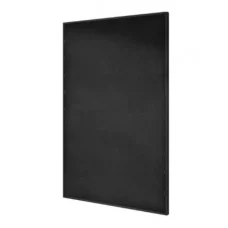
Perlight
300W Total Black Delta Mono PERC Solar Panel
Sold by Bimble Solar
A rigid solar panel for a correctly designed off-grid component system.
Best for: A rigid panel option for a site-designed office array where its dimensions and electrical limits fit.
- Panel power: 300 W
- Maximum-power voltage: 29.82 V
- Maximum-power current: 10.06 A
- Open-circuit voltage: 37.65 V
Check before buying: Match the product’s current manual to your calculator result and intended connections.
Affiliate linkView latest price
Victron Energy
SmartShunt 500A Battery Monitor with Bluetooth
Sold by Bimble Solar
A battery monitor for a compatible off-grid system; it does not add storage capacity.
Best for: Monitoring a compatible component-system battery; it does not increase runtime or output.
- Current rating: 500 A
- Minimum supply voltage: 6.5 V
- Maximum supply voltage: 70 V
- Minimum measured battery capacity: 1 Ah
Check before buying: Match the product’s current manual to your calculator result and intended connections.
Affiliate linkView latest price| Product | Verified specifications | Best for | Details |
|---|---|---|---|
| EcoFlowEcoFlow DELTA 3 Series Portable Power Station | Expandable capacity: 1-5 kWh; Capacity: 1024 Wh; batteryCapacityWh: 1024 Wh; Continuous output: 1800 W; surgeOutputW: 3600 W; maxSolarInputW: 500 W | Expandable storage. | View card |
| JackeryJackery Solar Generator 1000 v2 | Capacity: 1070 Wh; batteryCapacityWh: 1070 Wh; Continuous output: 1500 W; surgeOutputW: 3000 W; maxSolarInputW: 400 W | Manufacturer-listed solar bundle. | View card |
| BLUETTIBLUETTI AC50B with 100W Solar Panel | Capacity: 448 Wh; batteryCapacityWh: 448 Wh; Continuous output: 700 W; maxSolarInputW: 200 W; Panel power: 100 W | Compact office essentials. | View card |
| EcoFlowEcoFlow 220W Lightweight Portable Solar Panel | Rated panel power: 220 W | Compatible portable solar charging. | View card |
| Perlight 300W Total Black Delta Mono PERC Solar Panel | Panel power: 300 W; Maximum-power voltage: 29.82 V; Maximum-power current: 10.06 A; Open-circuit voltage: 37.65 V; Short-circuit current: 10.66 A; Panel efficiency: 19.91%; Height: 1504 mm; Width: 1002 mm; Thickness: 35 mm; Weight: 17 kg; Cell type: Mono PERC | Larger rigid off-grid arrays. | View card |
| Victron Energy SmartShunt 500A Battery Monitor with Bluetooth | Current rating: 500 A; Minimum supply voltage: 6.5 V; Maximum supply voltage: 70 V; Minimum measured battery capacity: 1 Ah; Maximum measured battery capacity: 9999 Ah; Current draw: 1 mA; Bluetooth: Built in; Communication: VE.Direct; Protection category: IP21; Weight: 0.32 kg; Height: 46 mm; Width: 120 mm; Depth: 54 mm | Component-battery monitoring. | View card |